The Resistance Paradox: Why Successful Transformations Don't Avoid Friction - They Navigate It
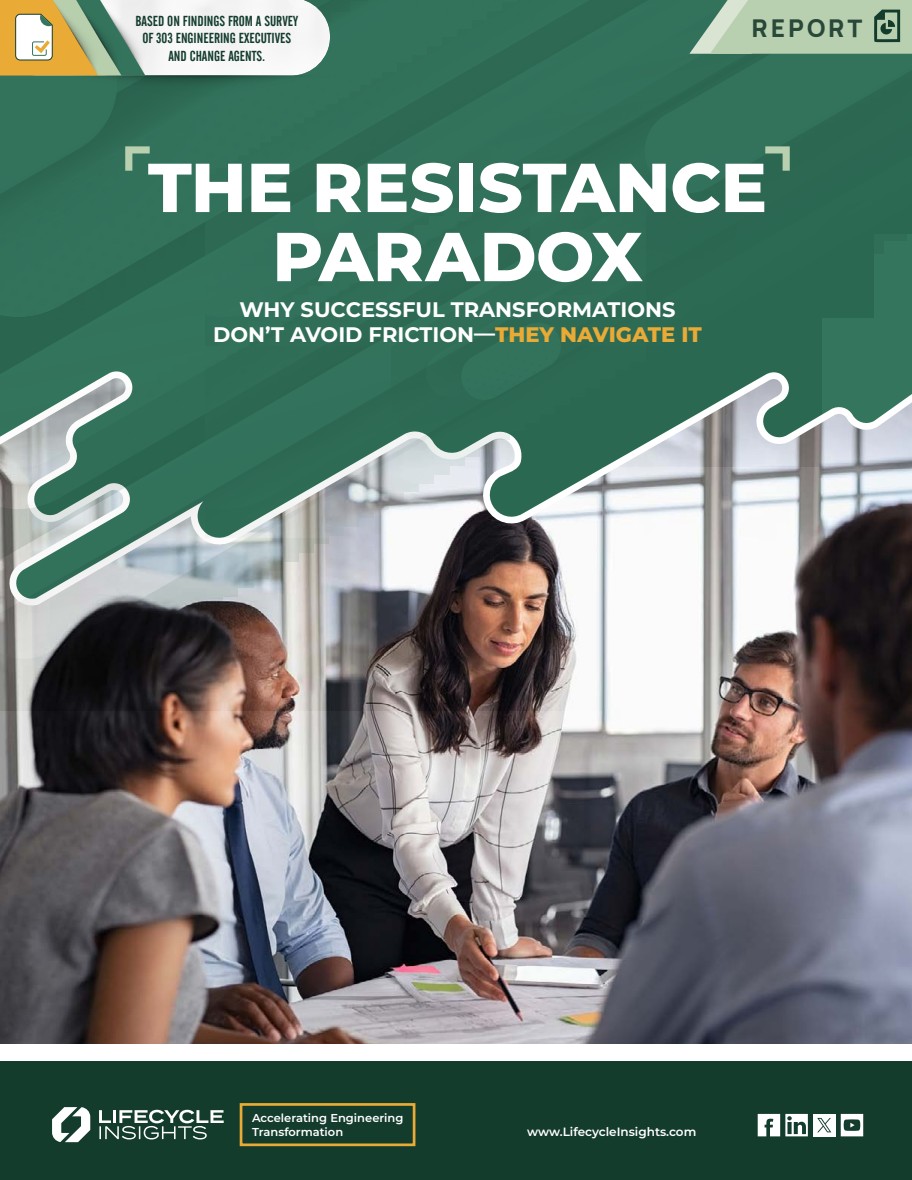
Data from 303 engineering executives and change agents reveals that 82% of initiatives succeed despite 77% facing significant resistance - and the specific activities that separate outstanding outcomes from merely strong ones.
Get the Full Report
Enter your details below for instant access to the complete findings and recommendations.
Key Findings
A preview of what the data reveals
of organizations achieve strong or outstanding success in their change initiatives
experience moderate, high, or extreme resistance during transformation
cite people-related challenges as the most difficult part of engineering transformation
of outstanding organizations use prototyping workshops, compared to only 50% of limited-success organizations
What You'll Learn
Inside the full report
The 2026 Lifecycle Insights Engineering Transformation Study of 303 engineering executives reveals a striking paradox: 82% of organizations achieve strong or outstanding initiative success while 77% simultaneously experience moderate to extreme internal resistance. Friction is not a failure signal—it is a structural feature of transformation.
Resistance doesn’t kill initiatives, but it taxes them. It drains executive bandwidth, disrupts productivity, and exacts an emotional toll, with 45% of respondents identifying people-related challenges as their hardest obstacle—outpacing technical and process issues combined.
The critical finding is that different support activities serve different purposes. Training reduces friction but doesn’t drive outstanding outcomes. Prototyping workshops, stakeholder listening sessions, and consistent executive sponsorship do—and they do so by converting resistance into feedback rather than treating it as an obstacle to overcome.
Download the full report to explore the data behind these findings and get actionable guidance on building the support portfolio that turns organizational friction into a strategic advantage—because the organizations that learn to work with resistance consistently outperform those that simply try to suppress it.
About the Research
The 2026 Lifecycle Insights Engineering Transformation Study surveyed 303 professionals in November and December 2025, targeting exclusively hard goods manufacturing organizations across five industry verticals: aerospace and defense, transportation and mobility, heavy equipment, and industrial machinery each represented roughly 21-22% of respondents, with medtech rounding out the sample at 13%. Company sizes spanned the full spectrum, with medium-sized organizations comprising the largest cohort at 40%, followed by large enterprises at 34% and smaller firms at 27%. Respondents skewed toward leadership, with executive management accounting for 65% of participants and engineering roles making up the remaining 35%. Geographically, the study achieved strong transatlantic coverage, with North America at 45% and Europe collectively representing 55%.
About the Author